
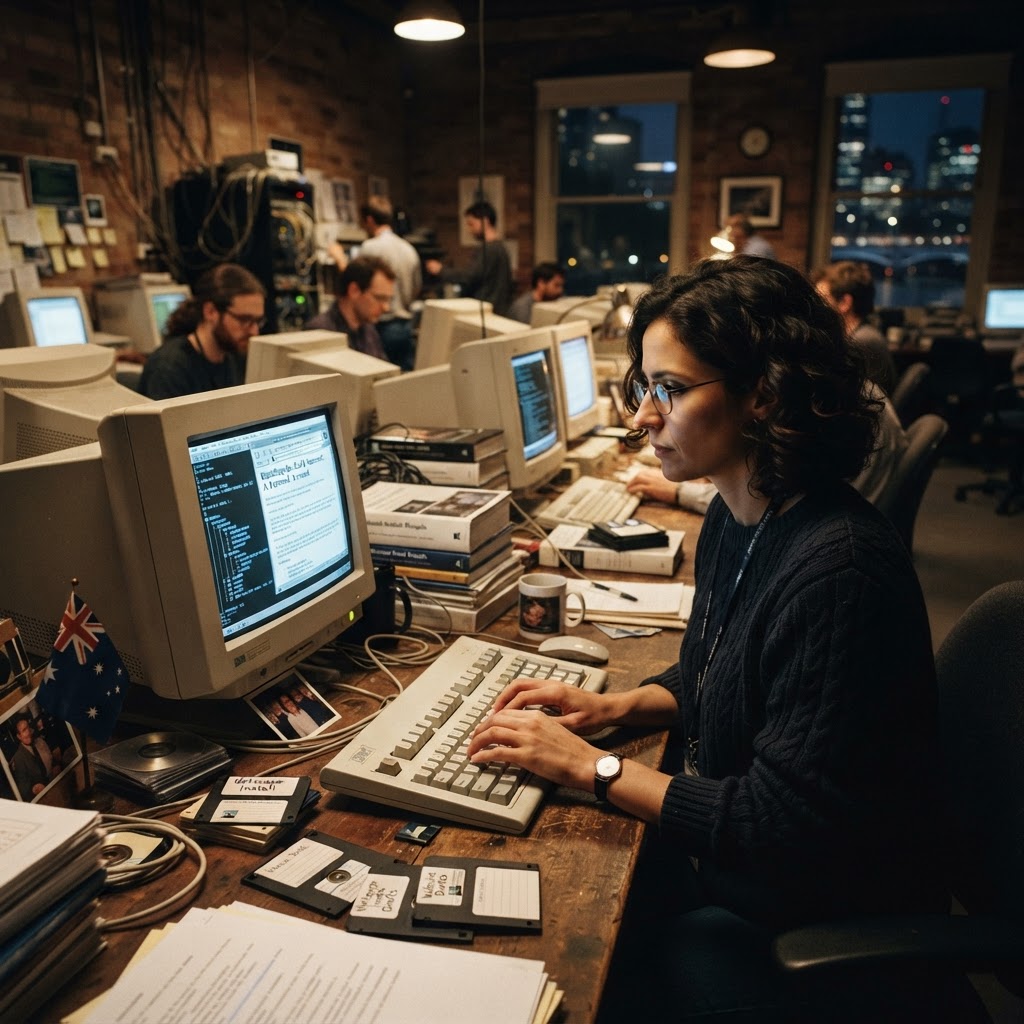
Building the Early Internet: A Personal Account from the Front Line
Melbourne, Sydney and the Internet Revolution (1996–2005)
When people look back at the creation of the internet, they often focus on the founders, the major companies, and the technologies that transformed the world.
Less often remembered are the thousands of people who built the foundations quietly: the people who organised information, secured networks, analysed threats, debated policy, and helped solve problems before those problems had established names.
I was one of those people.
Looking back now, I realise that the late 1990s and early 2000s were an extraordinary time to be working in technology. The internet was moving from a specialist network into a global platform that would change how people communicate, work, shop, and share information.
Many of us were simply doing our jobs. Only later did we realise we were helping build something historically significant.
Melbourne and the Rise of the Web Directory
In 1996, I moved to Melbourne, Australia, after a period working for Dr Solomon's AntiVirus and living in Boston. I remember that call into the Boston office, it was Microsoft, they had a problem with their Office macro language being used for malicious purposes. Macro viruses had arrived.
It was a fascinating time to be involved in technology, visits to MIT, talks about Oak(later renamed Java(script) and robots.txt). The commercial internet was beginning to emerge, and Australia had a growing community of people experimenting with what this new medium could become.
During this period, someone close to me joined LookSmart, I'd spotted an advert for 'content editors' I think it was, it looked like a good opportunity. LookSmart was one of the pioneering internet directory (and later adding search) companies founded in Australia in the mid-1990s.
Before today's search engines dominated the web, directories played a crucial role. The internet was expanding faster than anyone could manually understand it. Websites needed to be reviewed, categorised, and organised so that people could find useful information.
The work was a combination of editorial judgement and technology. It required people who could bring structure to an environment that was changing every day.
LookSmart became part of the wider global search ecosystem during a period when companies such as Yahoo! were among the most important gateways to the internet.
This was the era when search, directories, and online information discovery were being invented and skilled, hard working people could quickly rise up the management line in fast growing companies; often moving to California close to the hub of the 'information super highway'.
Sydney and the Challenge of Internet Security
After moving to Sydney on my own, my career moved into another critical area of the emerging internet: trust and security.
I became involved with Symantec, working with the Norton AntiVirus business, helping develop R&D capability for the Asia Pacific region and trying hopelessly really to be the PR voice during malware, or as we said then, virus breakouts.
At the time, the internet was expanding rapidly into businesses and homes, but security practices were still developing. Computer viruses and malware were becoming significant threats, and protecting users was becoming a fundamental requirement of the digital world.
Later, I joined MessageLabs, the UK-based email security company founded in 1999, filtering email for malware and spam was a new thing; they were leading the charge and I was Technical Director in APAC.
At MessageLabs, I worked on early analysis of phishing emails and emerging email-based threats alongside directing the build out of the firms data centre infrastructure in the region. I'd call HP and say "have you got another 20 of those DL 360's", the rack mounted servers we used.
Today, phishing is one of the most recognised forms of cybercrime. In those early days, however, many of the techniques, detection methods, and threat-analysis approaches were still being developed.
We were learning how attackers behaved, identifying patterns, and helping create systems that could protect organisations from threats that were only beginning to emerge.
After leaving MessageLabs my company (Cleartext Ltd) developed a product called Threat Forensics which fully automated malware analysis and matched the attack to the CVE vulnerabilities database if it could, in minutes; automation was the key to exponential malware growth. This was acquired by another Australian firm who themselves were acquired by Symantec.
Helping Shape the Rules of the Internet
Technology alone was not enough. The internet was becoming a major social and economic force, and it needed frameworks to guide how it developed.
I joined the Australian Internet Industry Association (IIA) and served a six-year term(2004-2010). Much of what we learned and rolled out in Australia landed in Europe, the USA and Asia; most governments were struggling. The Aussies are still leading with the recent mobile phone ban for under 16's, now taken up by the UK. I picket up an award from The Ministry for Public Security, Peoples Republic of China and the Hong Kong Computer Society, interesting times.
During that time, the industry was working through some of the fundamental questions that still matter today:
- How should privacy work in a connected world?
- Who owns digital content?
- How should copyright apply online?
- What responsibilities do internet companies have?
These discussions were taking place while the technology itself was still evolving.
Many of the principles being debated then became the foundations for later internet policy.
Different Roles, One Revolution
One of the most interesting things about that period was that people were contributing to the internet revolution from many different directions.
Some were building directories, search systems and organising information.
Some were securing networks and protecting users.
Some were developing business models.
Some were creating the legal and ethical frameworks needed for the digital age.
The work looked different, but it was all part of the same transformation.
The internet needed both discovery and trust.
It needed people asking:
"How do we help people find information?"
and also:
"How do we make sure people can safely use the systems that provide it?"
The People Behind the Technology
The history of the internet is often told through companies and products, but behind every milestone were thousands of individuals adapting to a world that was changing faster than anyone expected.
Many of us did not realise at the time that we were participating in history.
We were simply solving problems.
We were learning new technologies.
We were building systems that worked.
The internet was not created by a small group of famous names alone. It was built by engineers, editors, analysts, security professionals, policy specialists, and many others whose contributions were essential but often invisible.
Looking Back
The internet that exists today is both more powerful and more complicated than many of us imagined, those simple web site directories, basic anti-virus software and a learn it on the job attitude built the foundations.
The optimism of those early years has been balanced by new challenges: privacy concerns, cybersecurity threats, misinformation, and questions about how technology shapes society.
But the foundations remain.
I feel fortunate to have been present during those formative years, when the internet was still being shaped by curiosity, experimentation, and a belief that technology could connect people in new ways.
Many of us were there at the beginning, some of us went different ways and to different places; but we were there at the start as the information super highway gathered speed and importance in everyones life.
We just did not yet know how significant it would become.
Now in 2026 Ai has arrived and the next revolution is on us, the same issues are here with regard to copyright and privacy, security and risk. Here we go again(How Ai Is Changing the Economics), my last roll of the dice with the business before I retire.
Melbourne, Australia


